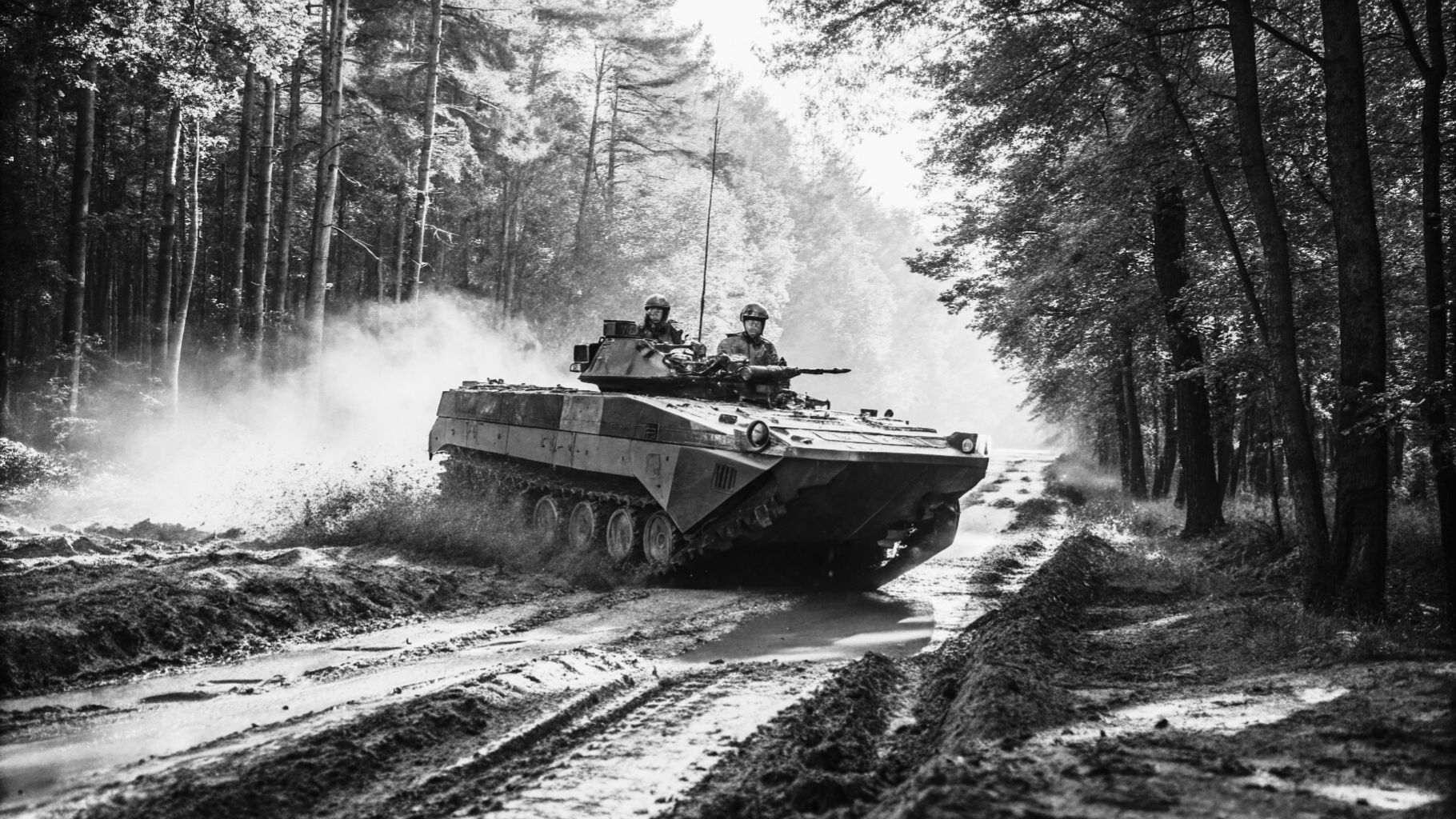
Armored vehicle rolling down a ship’s ramp, cutting through the surf before seamlessly advancing inland with a squad of Marines onboard. That is the role of the Amphibious Combat Vehicle (ACV) — a modern eight-wheeled amphibious platform reshaping how the United States Marine Corps projects combat power from sea to shore and beyond.
This guide explores what defines the ACV, how it operates, where it has been deployed, and how it is evolving for future battlefields.
What Is the ACV?
At its foundation, the ACV is a next-generation armored vehicle built to conduct ship-to-shore assaults, tactical mobility missions, and sustained operations in demanding littoral environments. Developed to replace the aging Assault Amphibious Vehicle (AAV), it offers significantly improved survivability, mobility, and modularity.
Its unique blend of amphibious capability, land maneuverability, and scalable protection makes it central to modern Marine amphibious doctrine — transitioning from naval vessels to contested coastlines and pushing inland while safeguarding its crew.
Why It Was Developed
The Marine Corps determined that legacy AAVs no longer met the demands of evolving threats in contested littoral zones and expeditionary operations. Greater protection against mines and improvised explosive devices, enhanced mobility, and improved integration with modern battlefield systems drove the need for a new design.
In 2018, BAE Systems secured the production contract, marking the start of a new era in amphibious warfare platforms. Although originally intended to replace more than 1,000 AAVs, the procurement objective was later adjusted to approximately 632 vehicles to align with updated force structure priorities.
How the ACV Operates
Dual-Domain Mobility
On land, the ACV’s 8×8 wheeled configuration and powerful diesel engine enable road speeds above 100 km/h (62 mph) and operational ranges exceeding 520 km (323 miles).
At sea, dual waterjet propulsion allows the vehicle to travel up to roughly 12 nautical miles (about 22 km) from ship to shore, maneuvering through surf with improved agility compared to earlier platforms.
This combination makes the ACV a true amphibious connector — capable of operating independently in open water before transitioning directly into ground combat.
Protection and Firepower
The ACV incorporates a V-shaped blast-deflecting hull, modular armor packages, blast-attenuating seating, and nuclear, biological, and chemical protection systems. These features shield occupants from mines, small arms fire, fragmentation, and improvised explosive threats.
Armament varies by configuration. Standard troop carrier versions use remote weapon stations armed with heavy machine guns or grenade launchers. The ACV-30 variant mounts a stabilized 30 mm cannon for enhanced direct fire support against light armored vehicles and fortified targets.
Mission-Specific Variants
The ACV family includes several specialized models:
ACV-P (Personnel): Primary troop transport and assault platform
ACV-C (Command): Battlefield command and communications node
ACV-R (Recovery): Maintenance and vehicle recovery support
ACV-30: Direct fire support with a 30 mm cannon
Together, these variants provide mobility, coordination, recovery, and firepower within a unified amphibious fleet.
Operational Deployment
Following initial deliveries between 2020 and 2021, the ACV began replacing AAVs in frontline Marine units. It has since participated in exercises across the Indo-Pacific, including operations in Japan and the Philippines, demonstrating open-water performance and joint interoperability in contested littoral environments.
These deployments validate its role as a central element in expeditionary and joint force operations.
Looking Ahead
The ACV program continues to expand in both scale and capability. Future upgrades may include enhanced amphibious range and speed, optional manned-unmanned teaming concepts, active protection systems, electronic warfare integration, and expanded networking capabilities.
With ongoing modernization, the ACV is positioned to remain a cornerstone of amphibious warfare for decades to come.