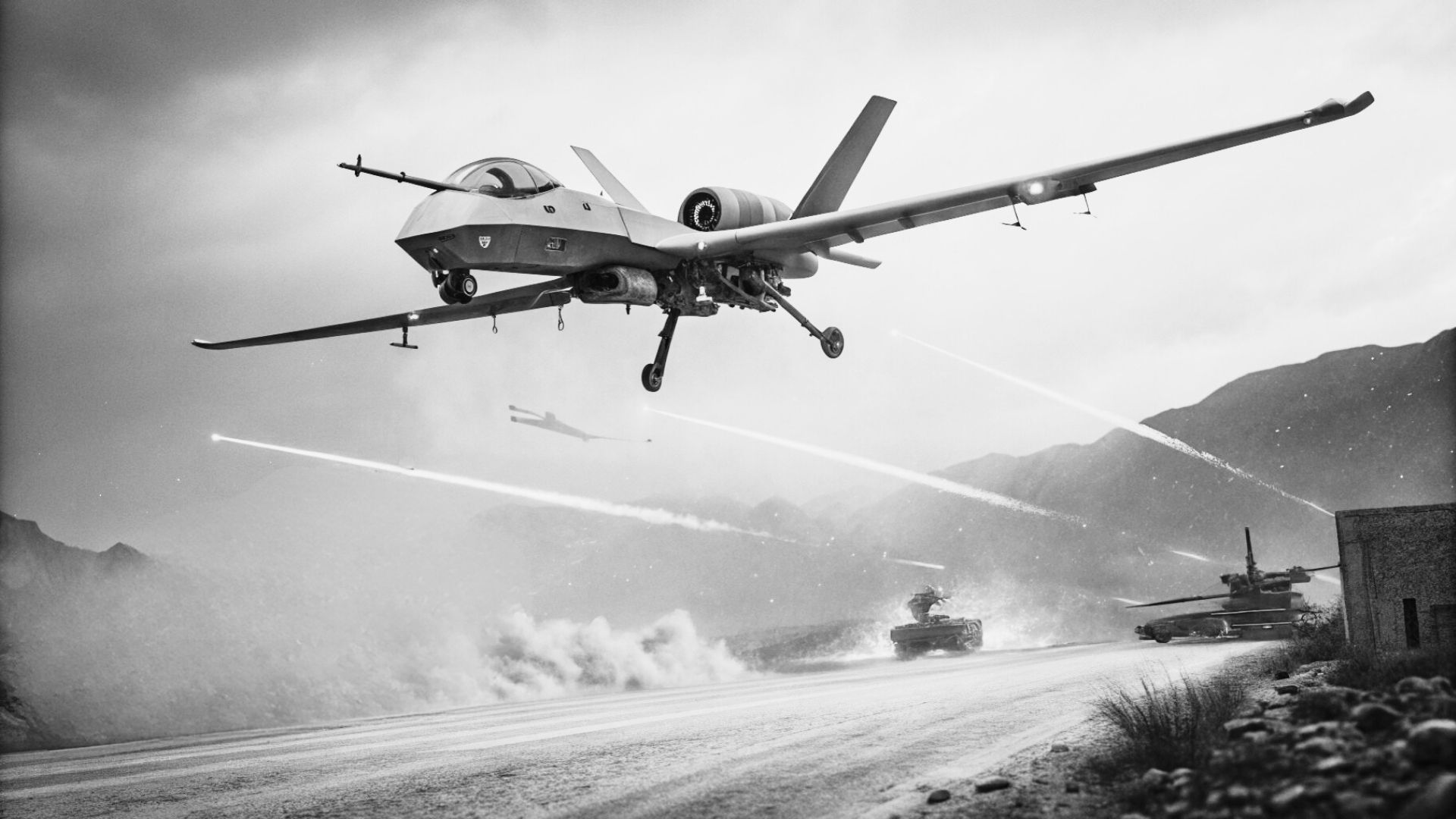
The U.S. Navy’s first operational MQ-25A Stingray has successfully completed its initial autonomous taxi test, Boeing has confirmed. While modest in scope, the milestone represents an important step toward integrating uncrewed aircraft into the routine and highly complex environment of aircraft carrier flight deck operations.
Boeing stated that the operational-standard MQ-25A conducted a series of autonomous ground movements in response to commands issued by Air Vehicle Pilots. Although the test took place ashore, Navy officials consider it a key prerequisite for eventual carrier deployment, where aircraft taxiing and positioning on crowded decks is among the most demanding and risk-intensive aspects of naval aviation.
Unlike earlier experimental unmanned demonstrators, the aircraft involved in the test was built to fleet-operational configuration, reinforcing the MQ-25A’s role as a deployable asset rather than a technology testbed. Upon command, the Stingray initiated movement, followed predefined taxi paths, executed controlled turns, and carried out stop-and-hold procedures designed to replicate carrier deck handling. Boeing engineers reported that the aircraft’s autonomy suite successfully integrated navigation inputs, control algorithms, and safety logic, enabling consistent and predictable behaviour in a dynamic operating environment. For the Navy, such reliability is critical, as flight deck operations allow little margin for error.
The MQ-25 programme stems from a broader reassessment of carrier aviation driven by years of combat experience and the emergence of long-range peer threats. By the mid-2010s, U.S. Navy analysis determined that the effective strike radius of carrier-based fighters was increasingly constrained by adversary capabilities. Rather than immediately pursuing a new manned platform, the Navy identified organic aerial refuelling as the most pressing operational shortfall. In August 2018, Boeing secured the MQ-25 Engineering and Manufacturing Development contract, valued at approximately USD 805 million, outperforming proposals from General Atomics and Lockheed Martin. The award covered four development aircraft, associated ground control systems, and support equipment, with subsequent contracts expanding the programme into low-rate initial production and confirming Boeing as prime contractor.
Operationally, the MQ-25A Stingray is intended to function as a force multiplier within the carrier air wing. Its primary mission is aerial refuelling, a task that has traditionally required F/A-18E/F Super Hornets to conduct buddy-tanking missions at the expense of combat availability. By shifting this role to an uncrewed platform, the Navy expects to free up significant fighter flight hours for strike, escort, and air defence missions. Powered by a Rolls-Royce AE 3007N turbofan engine, the MQ-25A is optimised for endurance and fuel efficiency, with the ability to offload more than 6,800 kg (15,000 lb) of fuel at operational distances, substantially extending the reach of F-35C and Super Hornet strike packages.
Beyond its tanker role, Navy planners view the MQ-25A as the foundation of a broader uncrewed aviation ecosystem aboard aircraft carriers. Its autonomy architecture, communications systems, and deck integration processes are designed with future mission growth in mind. Once carrier operations are fully established, the platform could take on additional roles including persistent intelligence, surveillance and reconnaissance support, airborne communications relay to extend command-and-control across distributed forces, and battlespace sensing to support long-range targeting. In doing so, the MQ-25A would allow manned aircraft to concentrate on kinetic missions while uncrewed systems provide persistence and coverage.